Practical Approaches to AI in 2026
If 2025 was the year that AI captured our imaginations, 2026 will be the year that AI is operationalized. Learn the four viable approaches to deploying AI agents within your business.

If 2025 was the year that AI captured our imaginations, 2026 will be the year that AI is operationalized. Last year saw agentic coding and AI assistants deployed into live business environments, but actual results were often inconsistent.
But as I write this in January 2026, we're living in a very different world. Millions of AI agents are driving real ROI inside organizations, driven by smarter models and supported by sophisticated infrastructure.
Despite all the rapid progress, AI isn't about to put us all out of the job. Over the coming months the most successful teams will employ AI as a partner, and a tool to gain leverage over their most valuable, strategic work.
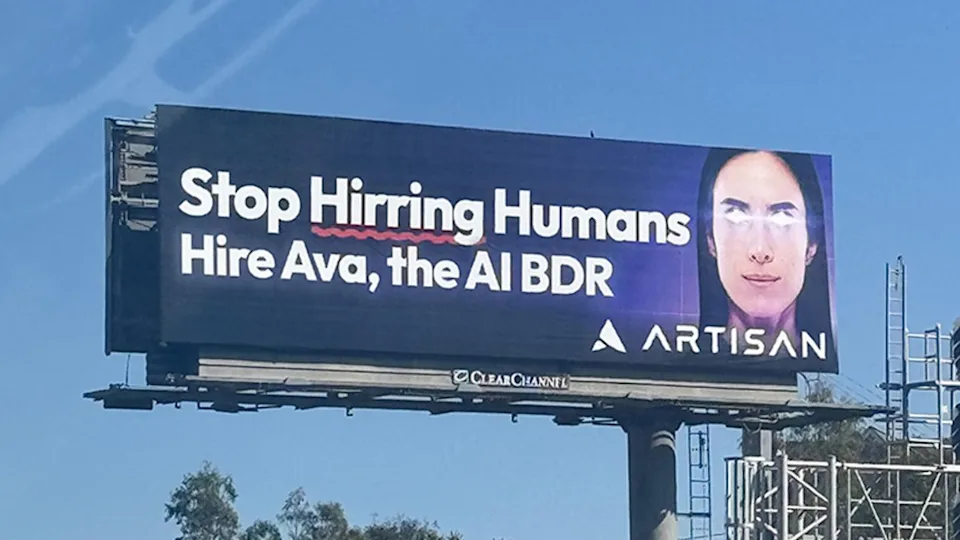
How businesses are planning to use AI
No technology is getting more attention from organizations right now than AI agents. What makes agents so powerful is their versatility. Coding, analytics, process automation — they can do it all. Agents can work within automated workflows at scale, or they can respond directly to user prompts.
Virtually every AI use case in business relies on agent technology at the core. However, agents cannot be successful by themselves in a vacuum. Agentic systems are most successful when they are deployed to support a holistic strategy that marries technology with human operations.
Over the last three years, we've implementing cutting-edge agentic AI systems for dozens of organizations, from scrappy startups to Fortune 100 enterprises. Some have successfully relied on AI to selectively automate tedious and error prone tasks. Others have delegated entire processes to AI, while reinvesting humans in deeply strategic and interpersonal functions.
In all, there are four viable approaches to operationalizing AI within a business. Each works well in the right context, and in fact can be complementary when deployed within the same or adjacent teams.
- Selective automation
- Human augmentation
- Exponential operations
- Complete automation
| Approach | What is it | Ideal workflows | How it generates ROI | Examples |
|---|---|---|---|---|
| Selective automation | AI agents automate tedious subtasks within existing roles | Repetitive, low-variance (document processing, email drafting, QA) | Efficiency gains + humans reallocated to higher-value work | Clay enrichment, n8n intake routing, Gumloop doc processing |
| Human augmentation | AI agents complete entire tasks end-to-end under human direction | Ad-hoc, requiring human judgement | Knowledge workers become multiples more productive | Cursor/Claude Code, Harvey (legal), Runway (video) |
| Exponential operations | Orchestrating dozens of parallel agents toward coordinated goals | High-volume experimentation, multi-workstream initiatives | 10x+ output multipliers; small teams operate like large orgs | Compounding Engineering, parallel A/B testing systems |
| Complete automation | Fully autonomous AI replaces entire roles or functions | Legible, bounded-risk, high telemetry | 24/7 operation at fraction of labor cost | Invoice processing, appointment scheduling, tier-1 support |
Which approach(es) to take depends on several factors, such as a function's scope and autonomy, the available infrastructure, and your internal capacity for building and supporting AI systems. (If you're still getting up to speed on what AI agents actually are and how they work, start with my primer on AI agents for operators.)
Section 1: Selective Automation
What is selective automation?
Selective automation is the most straightforward application of AI agents. It's also the one that has been most widely adopted to date because the technology is relatively more mature and full automation is often infeasible.
The idea is simple: rather than trying to automate sales reps or accountants, instead you automate the lowest-value and most tedious parts of each job. Document processing, question answering, web research, quality testing, and email writing all fall into this bucket.
It's the next evolution of RPA, but this time with an AI agent sitting at the center. Automations are triggered when certain events occur or certain criteria are met (e.g. when issue is submitted; on a schedule every 2 days). AI agents ingest data, take action using tools available, and return an output once they have accomplished their task. The goal-orientation and adaptability of these systems dramatically increases their power compared with traditional RPA.
What workflows are best for selective automation?
Nevertheless, because these automations are set-and-forget, the inputs and outputs must be fairly constrained. This makes them the most rigid out of all agentic systems. Therefore, the more repetitive and low-variance a workflow is, the better a candidate it is for this style of AI.
Selective automation is comparative advantage in action. AI agents are exceptional at many of the repetitive, data-heavy tasks that humans often struggle with. Conversely, humans excel at tasks that require creativity, expert judgement, and interpersonal skills. Reallocating the former from humans to AI agents delivers immediate productivity gains and frees up people to do more of what they do best.
How does selective automation generate ROI?
ROI comes from two dynamics: AI completes tasks faster and cheaper, and humans reallocate time to higher-margin work.
What happens next depends on the role. In positions with unlimited high-value work—engineers buried in tech debt, for instance—productivity compounds. Headcount stays flat while output grows.
In roles with fixed demand, like recruiting, teams consolidate. But outright cuts are rare. More often, roles expand in scope. SDRs become full-cycle AEs. Specialists become generalists. The job changes shape rather than disappearing.
Most teams have adopted some selective automation. Few have gone far enough. Cost, capability gaps, and internal politics still hold most organizations back.
Examples of selective automation
Lead enrichment and routing (Clay). When a new lead hits your CRM, Clay enriches it with firmographic data—company size, tech stack, funding stage—then scores and routes it to the right rep. What used to take an SDR 15 minutes per lead now happens in seconds, with better data.
Support ticket triage (n8n). Incoming tickets trigger an n8n workflow that classifies intent, extracts key details, and routes to the appropriate queue. Urgent issues get escalated automatically. Routine requests get templated responses drafted for agent review. Tier-1 volume drops 30-40%.
Invoice processing (Gumloop). Gumloop ingests invoices from email, extracts line items, matches against POs, and flags discrepancies for AP review. The AI handles formatting variance across vendors that would break traditional OCR. Processing time drops from days to hours.
Section 2: Human Augmentation
What is human augmentation?
Human augmentation is an approach that uses AI agents to make people far more productive than they were before, rather than replacing them wholesale. Rather than being a fancy AI-powered conveyor belt, augmentation is the Ironman fantasy come to life.
Most of the newest AI products on the market today fall into this category. They often resemble ChatGPT or Gemini because most use a chat input as the main mode of interaction, alongside a traditional user interface. A critical difference, however, is the AI doesn't simply respond when queried. In an agentic augmentation product, an agent (or, more often, agents) is dispatched to complete an entire workflow end-to-end with objective success criteria.
What workflows are best for human augmentation?
More concretely, this might look like an engineer asking an AI agent to turn a design sketch into a working web application, or a project manager asking an AI agent to revise a slide deck using new web research. In both of these cases, the AI is serving as an augmentation to the human. It turns a task from goal to outcome fully autonomously, relying only on the human for direction and feedback.
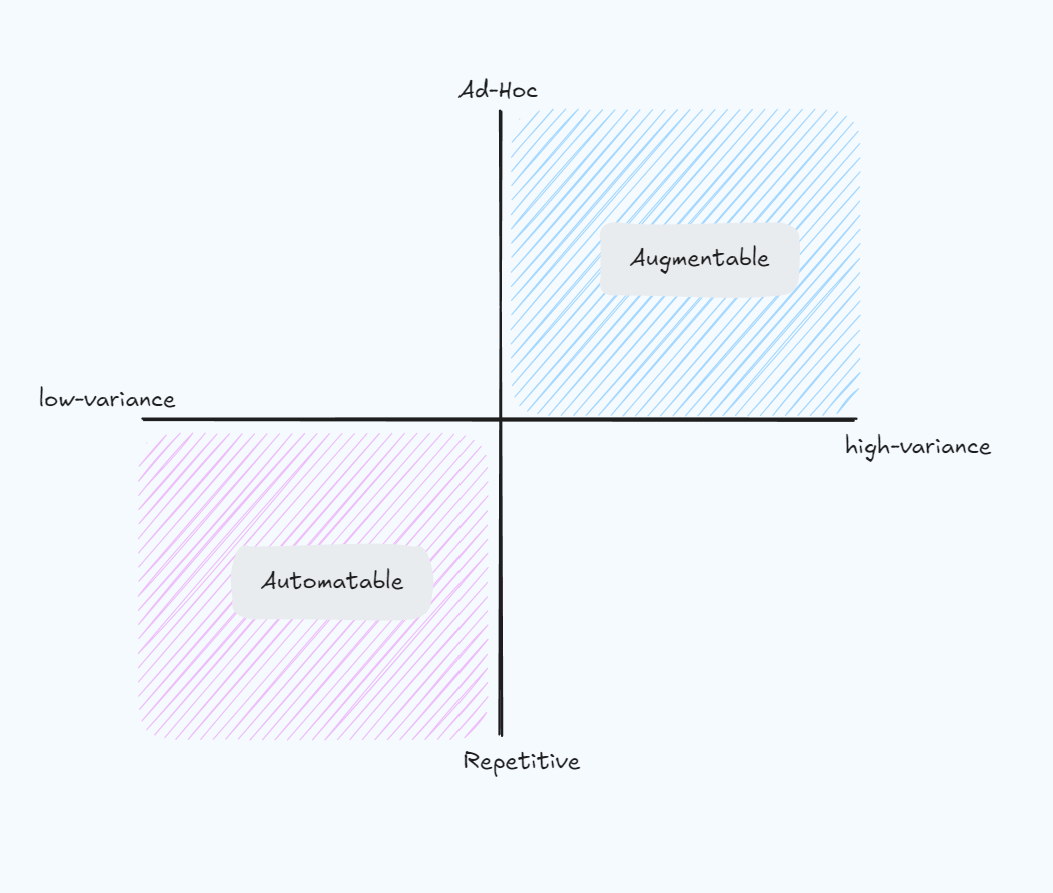
These products are used interactively by humans, rather than set-and-forget in the background. Human feedback loops are designed into the products, opening up space to handle larger scope and greater variance than RPA-with-LLM automation systems. AI meant to augment human abilities therefore tends to focus on workflows that are ad-hoc and still require human judgement.
How does human augmentation generate ROI?
ROI in this approach comes from making knowledge workers multiples more productive. This space is more nascent than selective automation, but is already attracting significant investment. According to Menlo Ventures, departmental AI spending hit $7.3 billion in 2025—up 4.1x year over year—with coding tools alone capturing $4 billion of that spend.
There are two primary reasons driving the excitement over this category. First is that most of the augmented work is in high value roles where exceptional insight and skill is rewarded, such as engineering. Second is many augmentation products are targeting niche roles where expertise is rare, creating a large opportunity for AI-augmented services. Harvey, now valued at $8 billion, has become the dominant player in legal AI—used by 8 of the 10 highest-grossing law firms. Similar vertical plays are emerging in accounting, tax, and other professional services where expertise commands premium rates.
Because humans are required to actively direct these agents, direct replacement isn't part of the conversation. However augmentation still leads to structural changes in organizations. Adopting augmentation tools provides organizations the ability to accomplish the same amount of output with less headcount. Used more creatively, these products enable non-experts to do technical work that previously required significant expertise.
Examples of human augmentation
AI coding is the best example of an augmentation category that has caused such a change. Technical teams are using agentic coding tools to ship more code more quickly, while nontechnical teams in marketing and design use vibe coding platforms to create proofs of concept. Unsurprisingly there are now many companies trying to build similar products for financial modeling, video editing, and other expert workflows.
Second and third order effects of this movement are exciting. The cost of building prototypes and testing ideas is declining and becoming accessible to non-experts. It's leading to an explosion of apps, content, ideas -- virtually anything that AI agents touch.
Section 3: Exponential Operations
What is exponential operations?
Exponential operations is the idea of agentic automation and augmentation together, taken to the extreme. It's less of a distinct product form factor than it is a system of orchestration and optimization around other AI agents. This area is the newest and least-explored domain of agentic systems. But in my opinion it's also the most exciting.
What workflows are best for exponential operations?
I like the framing by Gigi Levy-Weiss at venture capital firm NFX, who writes:
In the new agent world, you don't just open one window to open one task. You open fifty at once. Each agent you 'hire' should be working on a task in parallel, like musicians in an orchestra. And in more advanced cases, an agent will manage multiple agents for you, delivering only the aggregated outcomes of the work of all of them combined.
Once you make these two mental shifts, the result is that a 12-person startup starts to feel like a 1,200-person company.
…
This is a new kind of company: a thousand simultaneous experiments, constantly learning, and importantly implementing those learnings.
Let's be clear - no companies today are operating with 1000x performance multipliers. Though many startups are pushing well beyond 10x. Truly world-changing AI-powered productivity is on the horizon.
How does exponential operations generate ROI?
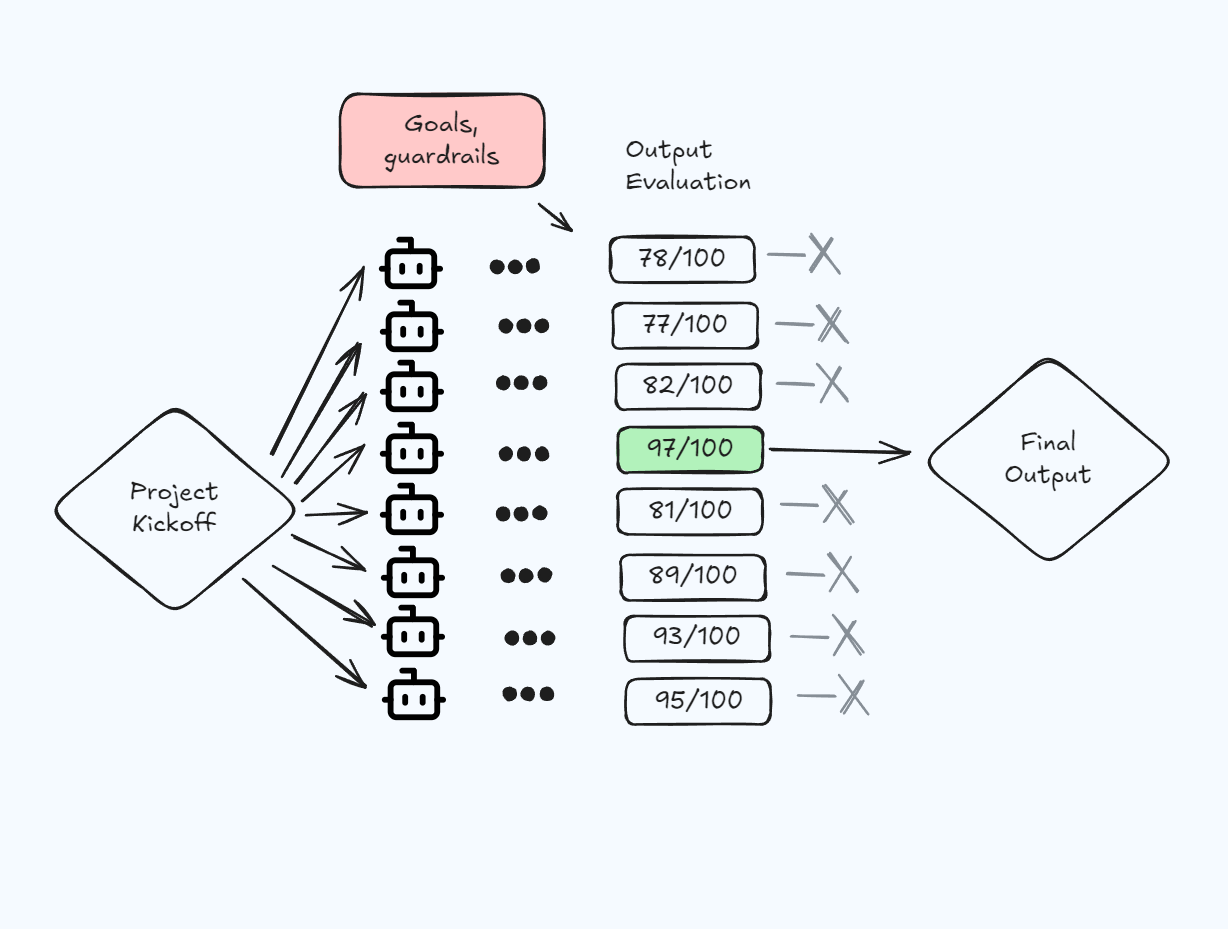
ROI comes from parallelization. Instead of one person working one problem, you orchestrate dozens of agents attacking a goal from multiple angles simultaneously. The math is simple: if each agent has a 10% chance of finding a good solution, running 50 in parallel virtually guarantees progress.
In practice, this looks like a founder kicking off 30 variations of a landing page, a growth team testing 100 outreach sequences, or an engineering lead exploring multiple architectural approaches before committing. The experiments that would take quarters now take days.
Today, this approach is mostly confined to startups and technical teams comfortable with orchestration tooling. It requires high tolerance for failure—most parallel attempts won't pan out—and strong feedback loops to learn from each run. Teams also need systems to prevent agents from "forgetting" context on long-running projects as their context windows fill up.
Adoption will expand as orchestration tools mature and organizations develop the operational discipline to run high-volume experiments. But the early adopters are already seeing 10x+ output multipliers.
Examples of exponential operations
Compounding Engineering, developed by Kieran Klaassen, shows what disciplined exponential operations looks like. The system tracks coding agent performance over time, feeding learnings back into future runs. Each iteration gets smarter. This pattern—run, measure, improve, repeat—will define exponential operations as it matures.
The scaling challenge isn't just technical. When dozens of agents produce more output than humans can review, guardrails become essential. Few teams today have the oversight infrastructure to run thousands of autonomous workflows safely. As adoption grows, expect significant investment in safety, monitoring, and governance tooling to catch up.
Section 4: Complete Automation
What is complete automation?
Complete automation is exactly what it sounds like. The AI owns the workflow from start to finish, unsupervised or maybe with a human in the loop. When it works, it's transformative. But right now it's only feasible in a narrow range of workflows. If you automate yourself too far over your skis you'll end up spending more time re-doing work than you originally saved.
What workflows are best for complete automation?
We've seen complete automation succeed when three things are true. First, the workflow is legible—clear inputs, clear outputs, obvious success criteria. You know what done looks like. Second, mistakes are bounded. An AI that miscategorizes an expense report might be annoying, but one that alienates a once-loyal client is catastrophic. Third, you need to have real telemetry that provides granular visibility into everything the AI does.
Workflows with ambiguous goals, lots of exceptions, or poor data are bad candidates. I've watched companies try to force full automation onto messy, subjective and create more problems than they solved. The leverage only materializes when the workflow fits.
How does complete automation generate ROI?
AI agents work around the clock, scale instantly, and cost a fraction of human labor. We've helped companies eliminate entire outsourced teams—invoice processing, appointment scheduling, tier-1 support—by deploying agents that handle 80%+ of volume without intervention.
But the failures I've been brought in to fix are also instructive. Companies that rush to automate customer-facing roles often discover that the 5% of edge cases their AI can't handle generate 80% of complaints. The cost savings evaporate when you factor in reputation damage and churn. Complete automation pays off when you're honest about what qualifies.
Examples of complete automation
Appointment scheduling is a clean example. Requests come in, the AI parses them, checks availability, sends confirmations. No human needed. It works because the task is structured and mistakes—double bookings, wrong times—are easy to catch and fix.
Invoice processing is similar. Invoices get ingested, matched to POs, routed for payment. Exceptions get flagged, but the bulk flows through untouched. Clear telemetry makes it obvious when something's off.
Tier-1 support is trickier but doable. Password resets, order status, FAQ answers—routine stuff that doesn't need a human. The key is having clear escalation paths. In the worst case a frustrated customer gets handed to a person, but that's fine as long as the customer experience is smooth.
Conclusion
Most companies will start with selective automation because it's the safest bet. You can easily automate the tedious stuff, free up your people, see quick wins. The teams pulling ahead are the ones combining approaches—using augmentation tools to make their best people dramatically more productive while automating the workflows that genuinely don't need human judgment.
The hard part that most struggle with is mapping workflows to each approach. We've watched companies blow months trying to fully automate processes that needed human oversight, or augment roles that should have been automated entirely. The framework matters less than the diagnosis.
If you take one thing from this piece, let it be this: start with the strategy and operations, not the technology. Map your workflows, identify where humans need the most leverage, then deploy automation.
Looking for a hands-on starting point? Pick the one workflow where your team loses the most time, and automate that first.
Frequently Asked Questions
Ready to make your AI work?
Book a 30-minute call to talk through what's not working and whether we can help.